



Painting Pavements
Painting Pavements
During a chance encounter in Florence, Farah met this fascinating street artist
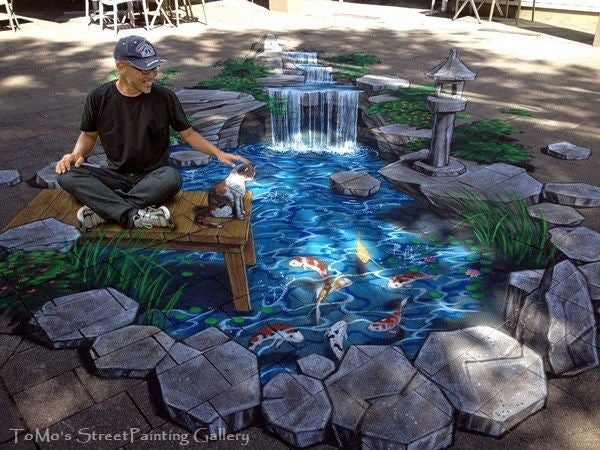
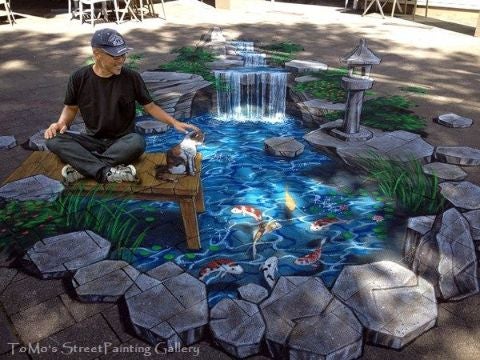
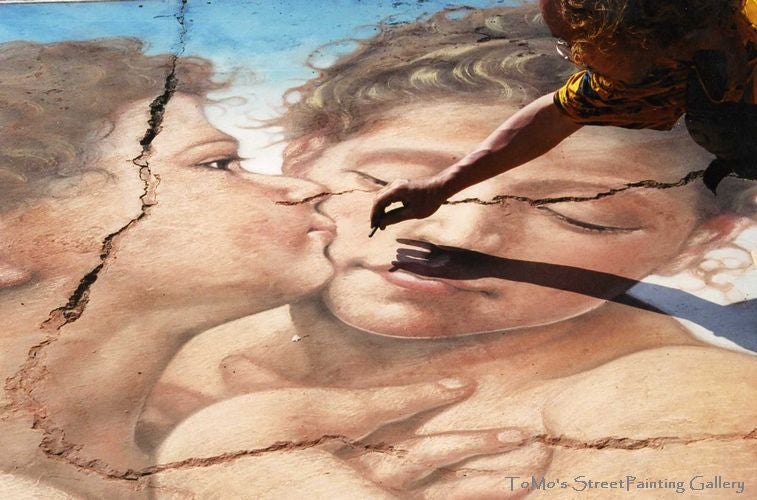
On a visit to Italy during the making of Farah Khan – A Bejewelled Life, Farah came across the work of a brilliant artist. It wasn’t framed or placed behind velvet ropes in a museum or gallery. It was right there, under her feet and all over a quaint street in Florence. She traced the art to its source, a smiling Japanese artist called Tomoteru Saito. His specialty? He creates masterpieces in chalk on the pavements and streets of cities around the world.
WATCH TOMO SAITO CREATE HIS JAPANESE GARDEN
The next time you’re travelling to Dubai or any major city in Europe or the USA, take a minute as you stroll through the heart of a city and look down—you might just see Botticelli’s Venus rising to meet you from the sidewalk. Tomo, as he is fondly known in the international street art community, creates ephemeral artworks that are masterful and whimsical, drawing passersby into engaging with their surroundings instead of hurrying past to the next item on their itinerary. A Japanese koi pond on the pavements of Arnhem in the Netherlands, a flying bicycle on the broad sidewalks of Dubai, a 3D T-Rex tearing its way out of the streets of New Jersey. The 57-year-old artist hails from Osaka, Japan, lives and works in Florence, and specialises in a particular form of Italian chalk art called Madonnaro street painting.
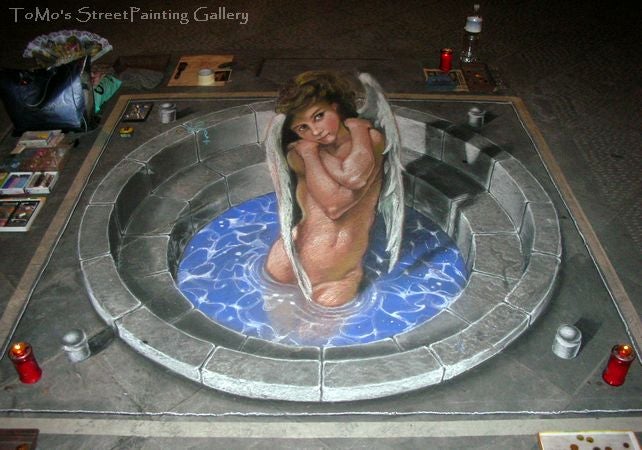
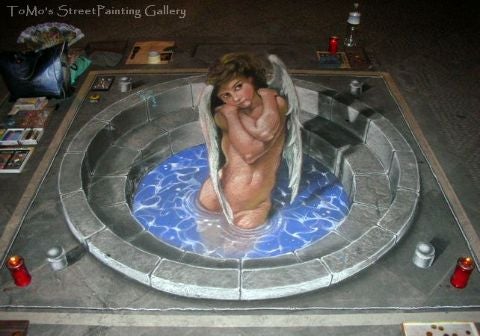
An architect by profession, Tomo started chalking on the streets of his home city in 1989. It was only after graduating from The Art Institute of Florence Lorenzo de’ Medici in 1997 that he took it up as a serious profession. He tells us how he happened upon this interesting career. “I traveled a lot when I was young. The first time I saw a street painter in action was in New York in 1984. I remember thinking to myself, ‘That’s a nice job; I can go anywhere I want and make money even if I can't speak the language. I have to do that’." A Madonnaro in Italian refers to a pavement artist and the origins of the art form can be traced back to Catholic processional art. In medieval Italy, during festival time, the Madonnari created images of Virgin Mary or the patron saint of the town directly on the streets. These artists typically travelled from town to town within Europe, painting on sidewalks and public squares and living on donations. Celebrated Spanish Renaissance artist El Greco is believed to have practised the art form on his journey from Italy to Spain. Tomo says, “When you study art history, you realise that most art is invariably related to religion. I don't practice any specific religion, but I'm very interested in it. To me, Madonnaro is like a form of prayer.”
Like most artists Tomu finds inspiration all around but mostly from old paintings, contemporary photography, travel and films. “I love the work of many artists, but if I have to choose one it would have to be French painter William-Adolphe Bouguereau. His works are just beautiful, heavenly, gorgeous…” He favours working with quick-drying mediums like chalk, pastels, and pigments. Interestingly, even when he’s in the middle of working on a picture it always looks somewhat complete. “It’s a kind of street performance. I enjoy making something that nobody can purchase. My art is not for art critics, it’s for the public.” Tomo participates in street painting festivals across Europe, the US, Mexico, the UAE, Hong Kong and Japan. Among his many achievements, the one he’s most proud of is winning first place twice at the International Street Painting Festival in Grazie di Curtatone, Italy. “It is considered as Madonnaro's most traditional and prestigious prize and it’s special to be chosen among the Maestri Madonnari,” he says. Tomo has worked on a number of ambitious projects: In a Guinness World Records attempt to create the largest anamorphic aka three-dimensional pavement art in 2014, he joined forces with street artists from all over the world at Venice, Florida. He also single-handedly finished seven 3D paintings in front of QVC Japan’s new building in 2013, a project that posed challenges in terms of material (the commissioning team wanted the artworks to stay intact for six months), the weather, and the time frame. The artist is excited about the possibility of an eventual homecoming in the future—“I’d love to organize a street art event on a large scale in Japan.” All photographs are courtesy Tomoteru Saito's webpage (http://tomoteru.web.fc2.com/index.html)




Comments